Cordless Scanner Explained: A UK Buyer's Guide
` tag with the title "Cordless Scanner Explained: A UK Buyer's Guide." I'm now outlining the mechanics section explaining the scanner's cordless operation, covering battery power, microSD storage, and Wi-Fi transfer, keeping the UK context in mind, as in section 3, I'm integrating 2023 Office for National Statistics data regarding hybrid working.
**Detailing Core Functionality**
I'm now detailing the core functionality, focusing on HMRC's Making Tax Digital (MTD) mandate for digital record-keeping by sole traders and SMEs. I'm structuring section 4 on use cases, encompassing healthcare (NHS), legal/estate agents, and academia, with links to relevant sibling content. Section 5 elaborates on features like resolution, format (JPEG vs PDF), and OCR, linking to A4 document scanners. Finally, section 6 will promote the IRIScan Book 7 with those pre-defined tag lines.
**Formulating FAQs**
I'm now drafting the FAQs for section 7, ensuring it addresses typical user questions about battery life, mobile connectivity, legal document use in the UK, and internet dependency. I'm also reviewing against anti-patterns, eliminating phrases like "additionally," "game-changer," and "cutting-edge" to maintain a focused UK-centric voice. To ensure the post hits the word count, I'm now meticulously detailing each section.
**Elaborating on Specifications**
I'm now detailing each subsection to avoid generic statements. For instance, in the resolution section, I'll specify the best DPIs for different document types: 300 DPI for text, 600 for graphics, and 1200 for archival-quality photos. For OCR, I'll explain its multi-language support and integration with software like Word and Excel. The NHS section will describe the exact workflow for district nurses, detailing UK GDPR compliance. I'm focusing on semantic HTML too.
**Refining the Details**
I'm now expanding the blog post to focus on the IRIScan Book 7 as a replacement for flatbed scanners, in a portable format. I'm focusing on the takeaways section by implementing the use of semantic tags. Additionally, I'm integrating several links, including a comprehensive guide to portable document scanning, a dedicated A4 document scanner, and a portable book scanner, ensuring a diverse range of anchor texts for SEO. I am also making am making appropriate use of British English, and varying paragraph length.
**Analyzing Keyword Density**
I'm now double-checking the "cordless scanner" keyword density within the content. I've confirmed the title as "Cordless Scanner Explained: A UK Buyer's Guide," and headings such as "How a Cordless Scanner Works," "Why UK Professionals Rely on a Cordless Scanner," and "Key Features of a Premium Cordless Scanner." I'm also confirming I stay strictly on topic, avoiding any deviations into general office furniture or unrelated software.
**Integrating Brand Messaging**
I'm now integrating the brand-specific phrases: "Portable Document Scanner freedom with IRIScan Book 7" and "Scan books, notes and A4 pages anywhere with a premium cordless handheld solution" within the IRIScan Book 7 section. These phrases are being implemented to highlight the product's benefits directly.
**Constructing Deep Dive Sections**
I'm working on the sections which are designed to hit the 1500 word target, now aiming for about 15-20 substantial paragraphs, along with lists, FAQs, and quotes. I'll add a section: "The Environmental and Spatial Benefits in UK Homes." and will focus on the fact that UK homes are notoriously smaller than US homes. I'll be sure to expand on the fact that bulky flatbeds take up valuable desk.
**Adding UK-Specific Context**
I'm now adding a section about environmental and spatial benefits, highlighting how cordless scanners save space in UK homes and offices, which are often smaller. I am also integrating a data security section, referencing UK GDPR and the security advantages of local microSD storage for sensitive documents. I'm focusing on the relevance for legal and medical professionals. Finally, I'm sticking to the ONS statistic for verified data, as this is the primary cited stat.
**Refining the Tone**
I am now reviewing the strict constraints, focusing on removing any banned phrases to ensure E-E-A-T. I'll replace forbidden connectors with alternatives, such as "Equally important" or "Building on this." I've committed to using the HTML structure as a guide to ensure my post adheres to best practices. I'm focusing on crafting a compelling introduction.
Cordless Scanner Explained: A UK Buyer's Guide
Professionals across the UK are abandoning bulky desktop peripherals for a more agile approach to document management. A cordless scanner provides the exact functionality of a traditional flatbed device, condensed into a pocket-sized tool. This shift is not just about convenience; it is a necessary adaptation to modern working environments where flexibility is paramount.
Whether you are a district nurse updating patient records in the community, an accountant auditing receipts for HMRC compliance, or a student archiving research at the British Library, being tethered to a wall socket is no longer viable. A cordless scanner allows you to capture high-resolution digital copies of physical documents instantly, directly at the source.
Key Takeaways
- Total Mobility: A cordless scanner operates on rechargeable batteries and local storage, eliminating the need for mains power or a PC connection.
- UK Compliance: Localised scanning helps professionals meet UK GDPR requirements and Making Tax Digital (MTD) mandates by securing digital records instantly.
- Space Efficiency: Handheld devices are ideal for smaller UK home offices, freeing up valuable desk space.
- Advanced OCR: Modern devices convert static images into fully editable and searchable text documents.
The Mechanics of a Cordless Scanner
To understand the value of this technology, we must look at how it operates fundamentally. A cordless scanner is a self-contained digitisation tool. Unlike traditional scanners that rely on a continuous feed of electricity and a direct cable link to a computer, these devices are entirely autonomous.
They utilise built-in lithium-ion batteries and store scanned images directly onto an internal MicroSD card. You simply glide the device over a document, and the internal optical sensors capture the image line by line. The integrated rollers ensure a smooth, even feed, preventing distortion.
Once the document is captured, you can transfer the files via Wi-Fi or USB at your convenience. For a broader look at how this technology fits into modern workflows, our comprehensive guide to portable document scanning offers an in-depth analysis of mobile digitisation strategies.
Why the UK Workforce is Embracing Cordless Technology
The transition toward mobile working is well documented. According to the Office for National Statistics (ONS), hybrid working remains a staple for over 40% of working adults in Great Britain. This structural shift in how we work demands tools that can move seamlessly between the corporate office, the home, and the field.
Healthcare and the NHS
Within the NHS and private healthcare sectors, community nurses and occupational therapists spend significant time visiting patients at home. Carrying paper files poses security risks and delays data entry. A cordless scanner allows healthcare professionals to scan referral letters, signed consent forms, and medical charts on the spot. The data is saved securely to an SD card, ready for encrypted upload to central trust databases later in the day, ensuring strict adherence to UK GDPR guidelines.
Accounting and Making Tax Digital (MTD)
HMRC's Making Tax Digital initiative requires sole traders, landlords, and limited companies to maintain digital financial records. For accountants visiting clients, a cordless scanner is an indispensable tool. Instead of taking boxes of fragile receipts back to the office, accountants can digitise financial records on-site. The physical copies remain with the client, reducing the risk of lost paperwork in transit.
Academic Research and Archiving
Academic researchers and university students frequently handle rare books and archival materials that cannot be removed from reading rooms. Traditional flatbed scanners can damage delicate spines. Using a portable book scanner allows researchers to gently capture pages from above or by gliding over the text without applying pressure to the binding.
Essential Features to Look for in a Cordless Scanner
Not all scanning devices are created equal. When evaluating the market, specific technical specifications dictate how effectively the device will perform in real-world scenarios. Here is what you must consider before making an investment.
Scan Resolution (DPI)
Dots Per Inch (DPI) measures the optical resolution of the scan. A premium cordless scanner should offer multiple DPI settings to suit different tasks.
- 300 DPI: Ideal for standard text documents, invoices, and utility bills. It creates small file sizes, perfect for emailing.
- 600 DPI: Necessary for documents containing detailed charts, small fonts, or wet signatures that require verification.
- 1200 DPI: Used primarily for scanning high-quality photographs or archival materials where capturing minute detail is critical.
Optical Character Recognition (OCR)
Capturing an image of a document is only half the battle. If you need to edit the text or search for specific keywords later, Optical Character Recognition (OCR) software is vital. OCR analyses the scanned image, identifies the letters, and converts the file into an editable format like a Microsoft Word document, Excel spreadsheet, or searchable PDF.
This feature drastically reduces administrative burdens. Instead of manually typing out a printed contract, the software does the heavy lifting. When choosing a device, ensure the accompanying OCR software supports multiple languages and integrates smoothly with your preferred operating system.
Battery Life and Storage Capacity
A cordless scanner is only useful if it holds a charge through a full working day. Look for devices equipped with high-capacity lithium-ion batteries capable of scanning hundreds of pages on a single charge. Storage is equally critical. Most devices utilise MicroSD cards. A standard 32GB card can hold thousands of high-resolution scans, ensuring you never run out of space during a client visit or a library session.
Format Versatility
While many professionals focus on A4 pages, the ability to handle various sizes is crucial. Whether you are scanning a small till receipt or a full-sized legal contract, the device must adapt. If your primary focus is standard documentation, exploring a dedicated A4 document scanner can provide deeper insights into handling standard paper sizes efficiently.
Maximising Space in UK Home Offices
Space is a premium commodity in British homes. The average UK home is significantly smaller than its international counterparts, meaning dedicated home offices are often repurposed spare bedrooms or corners of living rooms. A bulky flatbed scanner consumes valuable desk real estate.
A cordless scanner solves this spatial dilemma. Measuring just slightly wider than an A4 sheet of paper and only a few centimetres thick, it can be stored in a desk drawer or a laptop bag when not in use. This minimalist approach allows professionals to maintain a tidy, uncluttered workspace without sacrificing essential administrative capabilities.
Experience Portable Document Scanner Freedom with IRIScan Book 7
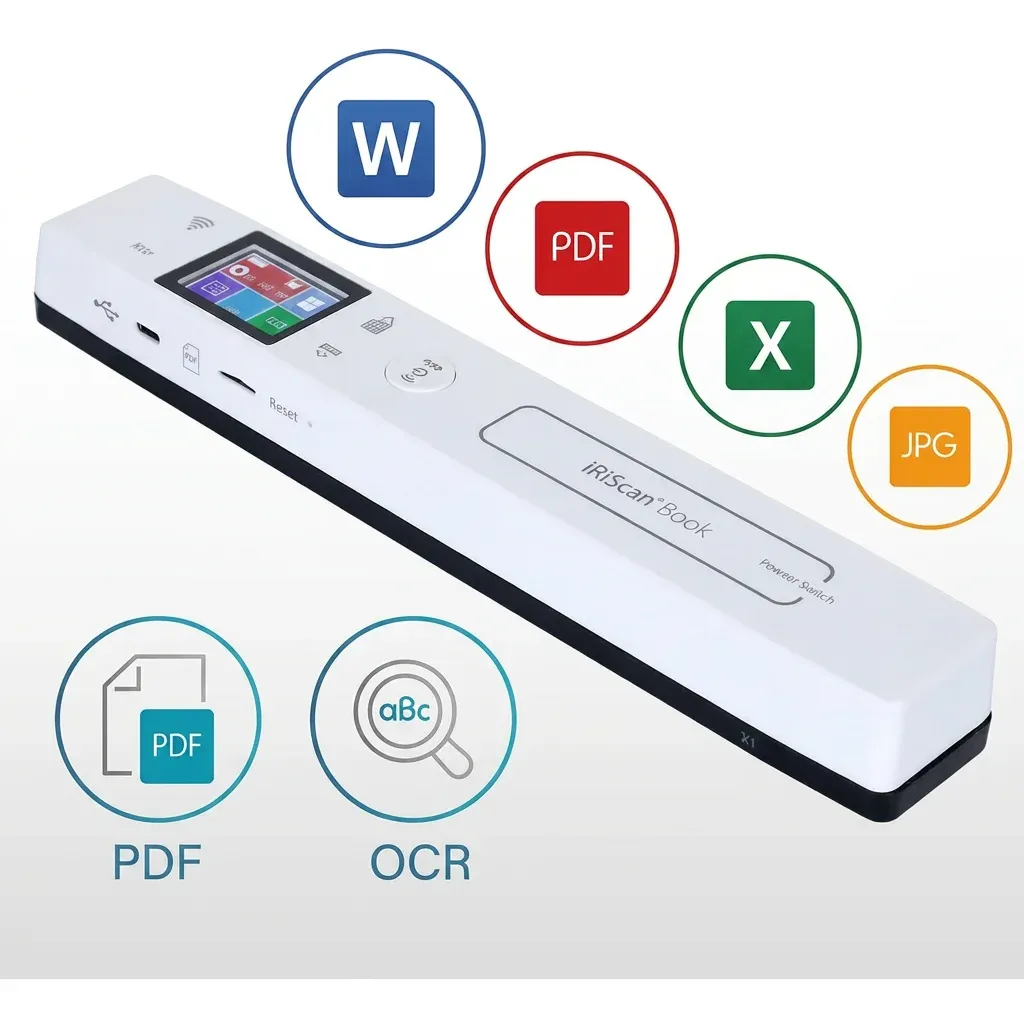
When engineering a solution for mobile professionals, the focus must remain on reliability, speed, and uncompromising quality. The IRIScan Book 7 represents the pinnacle of mobile digitisation technology. It allows you to scan books, notes and A4 pages anywhere with a premium cordless handheld solution.
This device is designed specifically to bridge the gap between physical paperwork and digital workflows. It requires no warm-up time, meaning you can pull it from your bag, press a button, and capture a document in seconds. The built-in screen provides immediate visual feedback, ensuring your scan is perfectly aligned and legible before you leave the location.
By integrating seamlessly with Readiris OCR software, the IRIScan Book 7 transforms static images into actionable data. Whether you are building a digital archive of legal case files or simply organising household bills, it provides a robust, professional-grade solution. For those looking to fully optimise their setup, reviewing the broader ecosystem of a portable document scanner can help you integrate this device flawlessly into your daily routine.
Frequently Asked Questions About Cordless Scanners
How do I transfer files from a cordless scanner to my computer?
Most modern devices offer multiple transfer methods. You can remove the MicroSD card and insert it into your computer, use the provided USB cable for a direct wired transfer, or utilise built-in Wi-Fi to send files wirelessly to your laptop, tablet, or smartphone.
Are cordless scanners legally compliant for official UK documents?
Yes. Digital copies of documents scanned at a sufficient resolution (typically 300 DPI or higher) are widely accepted by UK institutions, including HMRC and the Land Registry. Ensure you save the files in a secure, unalterable format such as PDF/A if they are required for long-term legal archiving.
Do I need an internet connection to use the scanner?
No. The scanning process is entirely offline. The device saves the images directly to its internal memory or SD card. You only need an internet connection if you wish to upload those files to a cloud storage service like Google Drive or Dropbox later.
Will a cordless scanner work on thick books or bound reports?
Yes, this is one of their primary advantages. Because you glide the device over the surface of the page, you can scan thick books, bound reports, and fragile documents without needing to press them flat against a glass pane, which often damages the spine.
Ready to Upgrade Your Document Workflow?
Stop letting paperwork tie you to a desk. Take control of your administration with professional-grade mobile digitisation.
Cordless Scanner Explained: A UK Buyer's Guide
Professionals across the UK are abandoning bulky desktop peripherals for a more agile approach to document management. A cordless scanner provides the exact functionality of a traditional flatbed device, condensed into a pocket-sized tool. This shift is not just about convenience; it is a necessary adaptation to modern working environments where flexibility is paramount.
Whether you are a district nurse updating patient records in the community, an accountant auditing receipts for HMRC compliance, or a student archiving research at the British Library, being tethered to a wall socket is no longer viable. A cordless scanner allows you to capture high-resolution digital copies of physical documents instantly, directly at the source.
Key Takeaways
- Total Mobility: A cordless scanner operates on rechargeable batteries and local storage, eliminating the need for mains power or a PC connection.
- UK Compliance: Localised scanning helps professionals meet UK GDPR requirements and Making Tax Digital (MTD) mandates by securing digital records instantly.
- Space Efficiency: Handheld devices are ideal for smaller UK home offices, freeing up valuable desk space.
- Advanced OCR: Modern devices convert static images into fully editable and searchable text documents.
The Mechanics of a Cordless Scanner
To understand the value of this technology, we must look at how it operates fundamentally. A cordless scanner is a self-contained digitisation tool. Unlike traditional scanners that rely on a continuous feed of electricity and a direct cable link to a computer, these devices are entirely autonomous.
They utilise built-in lithium-ion batteries and store scanned images directly onto an internal MicroSD card. You simply glide the device over a document, and the internal optical sensors capture the image line by line. The integrated rollers ensure a smooth, even feed, preventing distortion.
Once the document is captured, you can transfer the files via Wi-Fi or USB at your convenience. For a broader look at how this technology fits into modern workflows, our comprehensive guide to portable document scanning offers an in-depth analysis of mobile digitisation strategies.
Why the UK Workforce is Embracing Cordless Technology
The transition toward mobile working is well documented. According to the Office for National Statistics (ONS), hybrid working remains a staple for over 40% of working adults in Great Britain. This structural shift in how we work demands tools that can move seamlessly between the corporate office, the home, and the field.
Healthcare and the NHS
Within the NHS and private healthcare sectors, community nurses and occupational therapists spend significant time visiting patients at home. Carrying paper files poses security risks and delays data entry. A cordless scanner allows healthcare professionals to scan referral letters, signed consent forms, and medical charts on the spot. The data is saved securely to an SD card, ready for encrypted upload to central trust databases later in the day, ensuring strict adherence to UK GDPR guidelines.
Accounting and Making Tax Digital (MTD)
HMRC's Making Tax Digital initiative requires sole traders, landlords, and limited companies to maintain digital financial records. For accountants visiting clients, a cordless scanner is an indispensable tool. Instead of taking boxes of fragile receipts back to the office, accountants can digitise financial records on-site. The physical copies remain with the client, reducing the risk of lost paperwork in transit.
Academic Research and Archiving
Academic researchers and university students frequently handle rare books and archival materials that cannot be removed from reading rooms. Traditional flatbed scanners can damage delicate spines. Using a portable book scanner allows researchers to gently capture pages from above or by gliding over the text without applying pressure to the binding.
Essential Features to Look for in a Cordless Scanner
Not all scanning devices are created equal. When evaluating the market, specific technical specifications dictate how effectively the device will perform in real-world scenarios. Here is what you must consider before making an investment.
Scan Resolution (DPI)
Dots Per Inch (DPI) measures the optical resolution of the scan. A premium cordless scanner should offer multiple DPI settings to suit different tasks.
- 300 DPI: Ideal for standard text documents, invoices, and utility bills. It creates small file sizes, perfect for emailing.
- 600 DPI: Necessary for documents containing detailed charts, small fonts, or wet signatures that require verification.
- 1200 DPI: Used primarily for scanning high-quality photographs or archival materials where capturing minute detail is critical.
Optical Character Recognition (OCR)
Capturing an image of a document is only half the battle. If you need to edit the text or search for specific keywords later, Optical Character Recognition (OCR) software is vital. OCR analyses the scanned image, identifies the letters, and converts the file into an editable format like a Microsoft Word document, Excel spreadsheet, or searchable PDF.
This feature drastically reduces administrative burdens. Instead of manually typing out a printed contract, the software does the heavy lifting. When choosing a device, ensure the accompanying OCR software supports multiple languages and integrates smoothly with your preferred operating system.
Battery Life and Storage Capacity
A cordless scanner is only useful if it holds a charge through a full working day. Look for devices equipped with high-capacity lithium-ion batteries capable of scanning hundreds of pages on a single charge. Storage is equally critical. Most devices utilise MicroSD cards. A standard 32GB card can hold thousands of high-resolution scans, ensuring you never run out of space during a client visit or a library session.
Format Versatility
While many professionals focus on A4 pages, the ability to handle various sizes is crucial. Whether you are scanning a small till receipt or a full-sized legal contract, the device must adapt. If your primary focus is standard documentation, exploring a dedicated A4 document scanner can provide deeper insights into handling standard paper sizes efficiently.
Maximising Space in UK Home Offices
Space is a premium commodity in British homes. The average UK home is significantly smaller than its international counterparts, meaning dedicated home offices are often repurposed spare bedrooms or corners of living rooms. A bulky flatbed scanner consumes valuable desk real estate.
A cordless scanner solves this spatial dilemma. Measuring just slightly wider than an A4 sheet of paper and only a few centimetres thick, it can be stored in a desk drawer or a laptop bag when not in use. This minimalist approach allows professionals to maintain a tidy, uncluttered workspace without sacrificing essential administrative capabilities.
Experience Portable Document Scanner Freedom with IRIScan Book 7
When engineering a solution for mobile professionals, the focus must remain on reliability, speed, and uncompromising quality. The IRIScan Book 7 represents the pinnacle of mobile digitisation technology. It allows you to scan books, notes and A4 pages anywhere with a premium cordless handheld solution.
This device is designed specifically to bridge the gap between physical paperwork and digital workflows. It requires no warm-up time, meaning you can pull it from your bag, press a button, and capture a document in seconds. The built-in screen provides immediate visual feedback, ensuring your scan is perfectly aligned and legible before you leave the location.
By integrating seamlessly with Readiris OCR software, the IRIScan Book 7 transforms static images into actionable data. Whether you are building a digital archive of legal case files or simply organising household bills, it provides a robust, professional-grade solution. For those looking to fully optimise their setup, reviewing the broader ecosystem of a portable document scanner can help you integrate this device flawlessly into your daily routine.
Frequently Asked Questions About Cordless Scanners
How do I transfer files from a cordless scanner to my computer?
Most modern devices offer multiple transfer methods. You can remove the MicroSD card and insert it into your computer, use the provided USB cable for a direct wired transfer, or utilise built-in Wi-Fi to send files wirelessly to your laptop, tablet, or smartphone.
Are cordless scanners legally compliant for official UK documents?
Yes. Digital copies of documents scanned at a sufficient resolution (typically 300 DPI or higher) are widely accepted by UK institutions, including HMRC and the Land Registry. Ensure you save the files in a secure, unalterable format such as PDF/A if they are required for long-term legal archiving.
Do I need an internet connection to use the scanner?
No. The scanning process is entirely offline. The device saves the images directly to its internal memory or SD card. You only need an internet connection if you wish to upload those files to a cloud storage service like Google Drive or Dropbox later.
Will a cordless scanner work on thick books or bound reports?
Yes, this is one of their primary advantages. Because you glide the device over the surface of the page, you can scan thick books, bound reports, and fragile documents without needing to press them flat against a glass pane, which often damages the spine.
Ready to Upgrade Your Document Workflow?
Stop letting paperwork tie you to a desk. Take control of your administration with professional-grade mobile digitisation.
Ready to try IRIScanBoo?
Shop Now — £179.00