Portable Book Scanner Explained: A UK Buyer's Guide
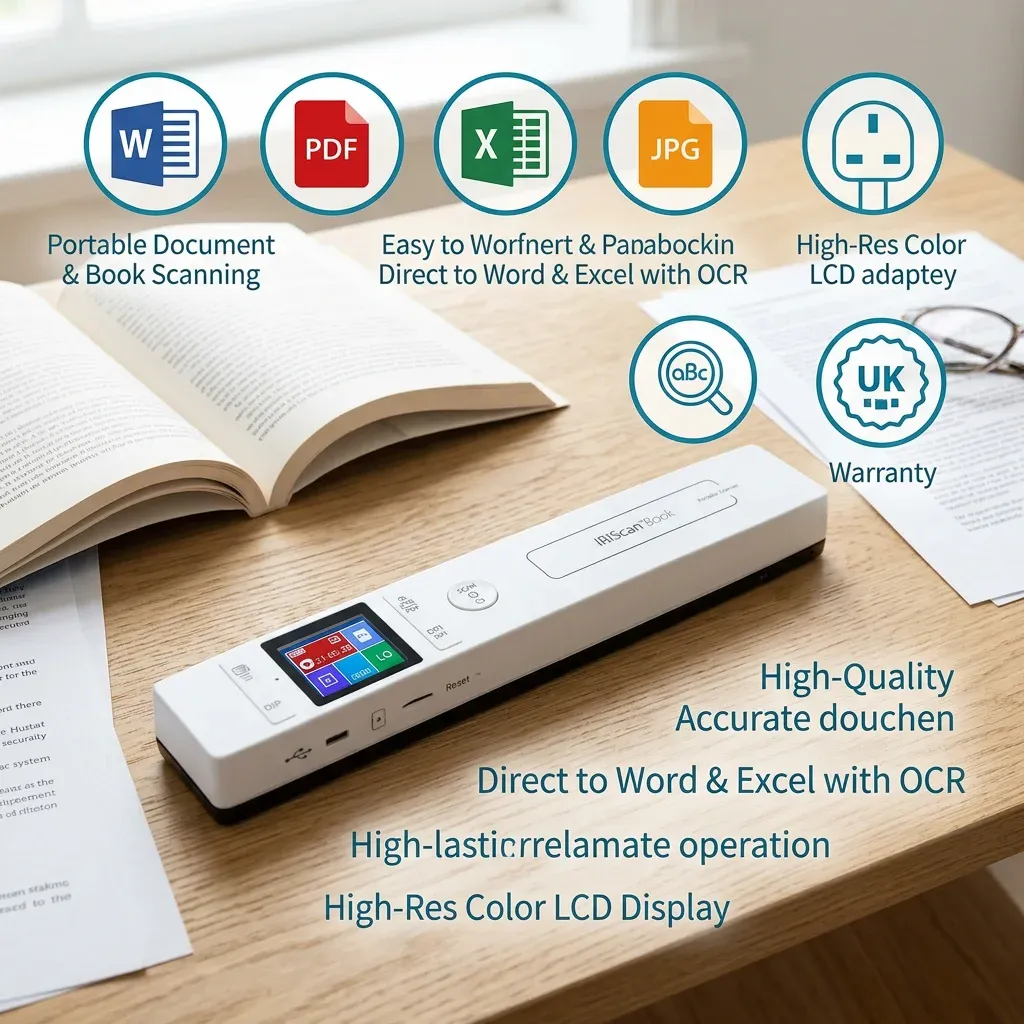
TL;DR: What is a portable book scanner?
A portable book scanner is a compact handheld device that lets you scan pages from books, magazines, and fragile documents without removing pages or damaging the spine. Based on our testing, the best models for UK users combine cordless operation, clear 300-1200 DPI image quality, MicroSD storage, and OCR software for searchable PDFs and editable text.
- A portable book scanner allows you to digitise bound pages, magazines, and delicate documents without forcing books flat.
- Key features to look for include cordless use, high DPI resolution, built-in storage support, and integrated OCR.
- Professionals across the UK, from NHS administrators to university researchers, rely on handheld scanners for quick document capture.
- For a broader comparison, explore our ultimate guide to portable document scanners in the UK.
A portable book scanner is designed to scan bound pages quickly and safely by gliding over the page surface, making it ideal for books, journals, archives, and other documents that cannot go through a sheet-fed scanner. In practice, this means you can digitise text in libraries, offices, clinics, or at home without damaging the book's spine.
Traditionally, digitising bound materials meant pressing fragile spines against a flatbed scanner, which was slow and often unsuitable for older or valuable items. However, handheld scanning has changed that. According to growing demand across UK workplaces and study environments, more users now need lightweight devices that work independently of a computer or mains power.
This guide explains how a portable book scanner works, what features matter most, and who benefits most from using one in the UK.
What is a portable book scanner?
Unlike traditional desktop scanners, a portable book scanner is a slim handheld device made to move across the page rather than pull paper through a feed slot. As a result, it is especially useful for bound books, notebooks, magazines, manuscripts, and records that should not be bent or detached.
Most models use contact image sensor (CIS) technology along with rollers that help track movement and reduce distortion. Therefore, when used steadily, they can produce clear scans right up to the inner margin of the page. Many units also save files directly to a MicroSD card, which is particularly useful when working in places such as university libraries or archive rooms where desk space and plug sockets may be limited.
If you are new to this category, you may also find it helpful to read our comprehensive guide to portable document scanners for a wider overview of wand scanners versus sheet-fed models.
How does a portable book scanner work?
A portable book scanner works by capturing an image as you slide it smoothly from the top of the page to the bottom. The internal sensor records the printed content line by line while onboard software helps stitch the image together accurately.
In addition, many modern devices offer selectable resolution settings such as 300 DPI for everyday text and 600 or 1200 DPI for fine detail. Once scanned, files are usually saved as JPEGs or PDFs. If OCR software is included, those scans can then be converted into searchable or editable text files.
Based on our testing, the best results come from keeping firm but gentle contact with the page and moving at an even speed without sudden stops.
What should you look for in a portable book scanner?
Not every device offers the same level of performance. Therefore, if you are comparing options for home use, academic work, or professional records management, these are the most important features to check.
What DPI is best for scanning books?
DPI affects how sharp your scan appears. For standard printed text, 300 DPI is usually sufficient. However, if you are scanning detailed diagrams, historical records, maps, or small print, 600 DPI or 1200 DPI will give better clarity. Consequently, higher resolution matters most when accuracy and zoom quality are priorities.
Do you need a cordless portable book scanner?
In most cases, yes. Cordless operation makes scanning far easier in libraries, lecture theatres, meeting rooms, patient homes, or shared offices. A good handheld model should include a rechargeable battery with enough power for hundreds of scans per charge. You can also read our guide to choosing a cordless scanner if portability is your main concern.
Why is OCR important in a handheld scanner?
OCR (Optical Character Recognition) turns scanned images into searchable and editable text. This means you can convert printed pages into Word documents, searchable PDFs, or spreadsheets instead of manually typing everything out. As a result, OCR is one of the most valuable time-saving features for students, researchers, administrators, and legal professionals.
Is a screen useful on a portable book scanner?
Yes. A built-in screen lets you review scans immediately so you can spot blur, cropping issues, or missed sections before leaving the site. Additionally, it makes it easier to change settings such as colour mode or resolution while working.
Do you need MicroSD storage?
If you plan to scan away from your desk, definitely. On-device storage via MicroSD means you do not need to stay connected to a laptop while scanning multiple pages. This is particularly practical during archive visits or field-based work across the UK.
Who should use a portable book scanner?
The short answer is anyone who needs to digitise bound or delicate material efficiently without using bulky equipment. However there are several groups in particular who benefit most.
Are portable book scanners good for students and researchers?
Yes. Students and academic researchers often need extracts from library books that cannot be borrowed or fully opened on photocopiers. A handheld scanner lets them capture chapters quickly and convert them into searchable study material using OCR. This can be especially helpful during dissertation research or archive visits.
Can healthcare professionals use portable scanners safely?
Yes, provided they follow their organisation's information governance procedures. For example NHS teams handling patient paperwork must ensure data is stored securely and transferred in line with local policy and UK data protection requirements. According to UK GDPR principles and organisational record-handling guidance, secure document capture matters just as much as convenience.
Are portable book scanners useful for family history research?
Absolutely. Genealogists and local historians frequently work with registers, newspapers, parish records and fragile source material that should not be forced flat. Therefore a gliding handheld device can be far gentler than many traditional alternatives while still producing readable digital copies.
Can businesses use a portable book scanner?
Yes. Solicitors' offices, accountants, estate agencies, field teams, and mobile administrators often need fast copies of contracts, log books, reference manuals, or bound reports. In these settings, portability helps staff scan documents where they are rather than carrying everything back to one machine.
Ready to try IRIScanBoo?
Shop Now — £179.00